What is AI Workflow Automation in 2026?
AI workflow automation is the practice of using artificial intelligence to design, execute, and optimize multi-step business processes with minimal or zero human intervention. Unlike traditional rule-based automation — which follows rigid if/then logic — AI-powered automation can interpret unstructured data, learn from patterns, make contextual decisions, and adapt to changing inputs in real time.
At its core, an AI-driven workflow is a sequence of connected tasks where at least one step involves machine learning, natural language processing, computer vision, or a large language model (LLM). These intelligent nodes allow the workflow to handle exceptions, extract meaning from emails or documents, generate content, classify data, and take appropriate action — all without a human in the loop.
AI Workflow Automation with n8n.io
What AI workflow automation means?
AI workflow automation is the process of using software to move data, trigger actions, and apply AI decisions across tools without constant human input. Instead of treating AI as a one-off prompt, the workflow connects it to real business processes such as lead routing, content generation, reporting, alerts, and customer support.
Why n8n fits this category?
n8n is built around node-based automation, which makes it useful for combining APIs, databases, LLMs, spreadsheets, and messaging tools in one flow. Recent coverage describes it as especially strong when teams need repeatable automation, branching logic, and workflows that go beyond simple no-code tasks.
How AI Workflow automation works?
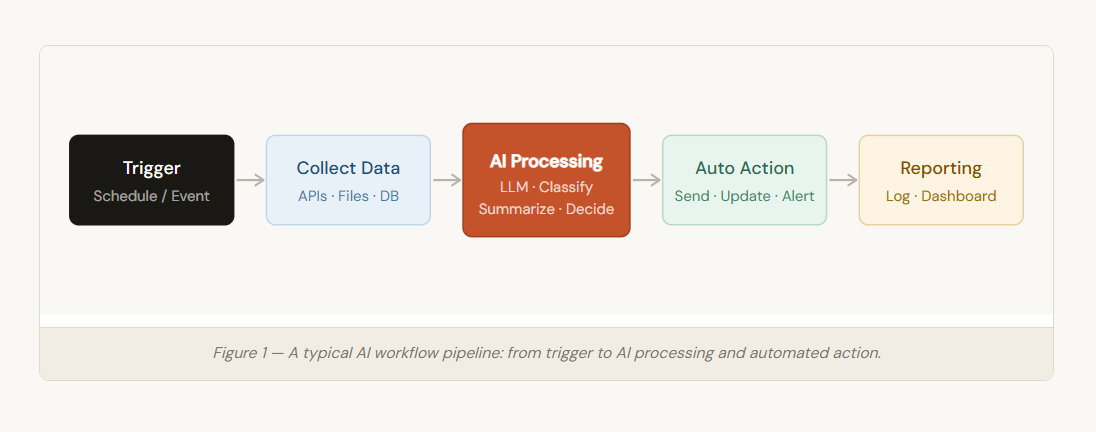
Modern AI workflow automation platforms operate on a node-based or event-driven architecture. Here’s the general anatomy:

N8n.io Pros
#1. Strong visual workflow builder
n8n’s drag-and-drop canvas makes automations easier to understand because each step is visible and connected in sequence. This is especially valuable for teams that need to document logic, hand off workflows, or troubleshoot complex processes.
#2. Flexible for AI plus business data
n8n can combine AI models with tools like Google Sheets, Slack, email, CRMs, and search APIs, which makes it useful for SEO, marketing ops, reporting, and data enrichment. That flexibility is one of the biggest reasons it is often recommended for real-world AI workflow automation.
#3. Good for complex logic
Unlike lightweight automation tools, n8n supports branching, retries, conditional paths, and error handling. This makes it better suited for multi-step business systems where a workflow needs to react differently depending on the data it receives.
#4. Self-hosting and privacy control
A major advantage of n8n is that teams can self-host it, which gives more control over data handling and infrastructure. That matters for companies dealing with sensitive information or compliance-heavy operations.
#5. Scales beyond one department
n8n is not limited to content or marketing use cases; it can also support sales operations, analytics, customer support, and internal process automation. That makes it a broader automation backbone rather than a single-purpose AI tool.
N8n.io Cons
#1. Steeper learning curve
n8n is powerful, but it is not as beginner-friendly as simpler AI automation tools. Users often need to think in workflows, data structures, and system logic rather than just prompts.
#2. Less plug-and-play
Many users prefer tools that work immediately with minimal setup, while n8n often requires more configuration. That can slow adoption for non-technical teams that want quick wins without technical onboarding
#3. Not an all-in-one AI suite
n8n can automate SEO and content workflows, but it is not itself an SEO platform, rank tracker, or AI writing suite. You still need separate tools for analysis, content strategy, and specialized marketing functions.
#4. Technical comfort helps
Because n8n is so flexible, users who are comfortable with APIs, webhooks, or structured logic get the most value from it. Teams without that background may need templates, training, or implementation support.
Top AI Workflow Automation Use Cases with n8n


N8n. io Frequently Asked Questions
What is AI workflow automation and how does it differ from traditional automation?
Traditional automation follows static rules — if X happens, do Y. AI workflow automation introduces intelligence into that pipeline. AI nodes can interpret unstructured inputs (emails, PDFs, images), make contextual decisions, generate text, classify data, and adapt their behavior based on learned patterns. The result is automation that handles exceptions gracefully rather than breaking whenever something unexpected occurs.
Is n8n really free to use?
Yes — the self-hosted version of n8n is free under the Sustainable Use License (fair-code). You can run unlimited workflows, unlimited executions, and use all core features on your own infrastructure at no cost. The paid n8n Cloud plans start at approximately $20/month and handle hosting, updates, and uptime for you.
Can n8n integrate with OpenAI and Claude (Anthropic)?
Absolutely. n8n has native nodes for OpenAI (GPT-4, DALL-E, Embeddings), Anthropic (Claude), Google Gemini, Mistral, Cohere, and more. Through LangChain integration, you can also chain multiple LLM providers, add memory, connect vector databases, and build complex multi-step AI reasoning chains within the visual workflow editor.
How hard is n8n to learn compared to Zapier?
n8n has a noticeably higher learning curve than Zapier. Zapier is designed for zero-code users and can be mastered in a few hours. n8n requires understanding of JSON data structures, JavaScript expressions for data transformation, and basic API concepts. Most developers become comfortable with n8n within a week; non-developers may need a few weeks to reach proficiency. The payoff is much greater power and flexibility.
What are the best n8n alternatives in 2026?
The top n8n alternatives include: Zapier (best for non-technical users, widest app catalog), Make (best for visual thinkers and marketing automation), Activepieces (open-source, simpler UX, growing AI features), Workato (enterprise-grade, expensive), and Langflow/Flowise (for purely AI-agent focused workflows). Your best choice depends on technical skill level, scale, and budget.
Can I build autonomous AI agents with n8n?
Yes. n8n introduced dedicated AI Agent nodes that support tool use, memory (short-term and long-term via vector stores), and autonomous multi-step reasoning. You can build agents that browse the web, query databases, send emails, create calendar events, and more — all orchestrated through LangChain-compatible agent loops. This makes n8n one of the most capable no-code platforms for agentic AI workflows as of 2025.
Is n8n suitable for enterprise use?
n8n’s Enterprise plan includes SSO/SAML, advanced role-based access control, audit logging, external secrets management, and dedicated support — making it viable for enterprise deployments. However, for very large organizations with complex governance needs, established enterprise iPaaS platforms like MuleSoft or Boomi may offer deeper compliance tooling and SLA guarantees. Mid-market companies with engineering teams tend to find n8n Enterprise an excellent fit.
Conclusion: AI workflow automation is no longer a competitive advantage — it’s quickly becoming a baseline expectation. n8n is a strong option for AI workflow automation because it combines flexibility, AI integrations, and complex logic in one system. Its main drawbacks are the learning curve and the need for more setup than beginner-friendly tools, but for teams that want scalable automation, it is one of the most capable choices available.
If you like my article, please read this too: Marblism AI Vs Relevance AI